by digitalplus | Feb 13, 2018 | Yoga
The word Bhakti is derived from a word ‘’bhaj’’ which means’’ to be attached to God’’.
Bhakti means a continuous, one directional and steady flow of pure love, devotion and adoration for one’s chosen Ideal (Ishtam) (The GODHEAD).The word Yoga is derived from a sanskrit word ‘’yuj’’ which means to combine, connect or join together. Yoga can be be defined as the union of the Jivatman (Individual Self or Finite )with the Paramatman(Universal Self or Infinite). The path of Bhakti or highest devotion is called Bhakti Yoga. It requires complete surrendering of one’s own self at the altar of one’s Chosen, Ideal/Ishtam.
Bhakti yoga is one of the paths for realizing one’s true identity or self realization. Bhakti is a deep and intense devotion for any SAGUNA(definite form) of one’s chosen Ideal/Godhead. There are a no of ways of reaching the ultimate reality. Karma Yoga, Jnana Yoga, Raja Yoga and Bhakti Yoga are the four main types of yoga for realizing one’s true self. Bhakti Yoga is the easiest and best way to reach the absolute reality in present times.Bhakti Yoga is the highest point of pure and intense love for one’s Ishtam(Chosen Ideal) .Bhakti yoga completely erases all the samskaras (mental impressions) related to our karmas (actions ). It also frees its followers from the chain of birth-life-death-rebirth cycle.
Bhakti : Its True Meaning
Sage Narada a devotee of lord Vishnu(his chosen ideal)defines Bhakti as:
- “Sa tvasmin parampremarupa”
Bhakti means true and unconditional love for one’s chosen ideal(God)without any personal desires or external reasons and conditions.
Bhakti is like nectar, which when one drinks ,leads to the experience of permanent bliss.
- “Yallabdhava puman sidhho bhavati amrito bhavati tripto bhavati”
After achieving Bhakti one reaches the state of perfection. The Bhakta(Devotee) attains immortality like God and all its desires are completely fulfilled. Through Bhakti or devotion a Bhakta goes beyond the worldly desires and bondage. It becomes a mere instrument in the hands of God. The Bhakta becomes free from the cycle of birth and death.
Ways of Realizing One’s Self through Bhakti Yoga
 Bhakti is not based on any conditional state of mind. It has no pre-conditions or pre-qualifications. There is no specific method or formula for Bhakti Yoga. The only condition required in Bhakti is to surrender all our actions at the feet of God and become egoless.
The path of Bhakti is particularly followed by people having a high emotional quotient. The Bhakta (devotee) is driven mainly by the power of pure love and sees one’s chosen ideal as an Incarnation of love. Prayer,Worship and Ritual are the primary means of Bhakti Yoga. The Bhakta(devotee) completely surrenders itself to it’s chosen ideal. The Bhakta directs and transforms its emotions into unconditional love and devotion. Chanting or Singing the praises of one’s chosen ideal is an important part of Bhakti Yoga. There are five main enemies of one ’s self viz anger, delusion, envy, pride and lust. They have to be given up completely for filling oneself with Bhakti or the extreme devotion towards one’s Chosen Ideal. As the crystals of sugar get dissolved in water and lose its identity completely so is the Bhakta who completely gives up his pride, ego, hatred, ill will and self identity for one’s chosen ideal.
Though Bhakti is endowed with God’s grace, yet it can be cultivated by constantly involving ourselves in various devotional practices. Bhakti brings us closer to God and its grace flows through us.
Types of Bhaktas and Some Famous Bhaktas
There are mainly four types of Bhaktas:
- Ârta (the distressed)
- Jijnâsu(the inquisitive)
- Arthârthee(the desirer of wealth)
- Jnâni(he, who is searching for knowledge of the Absolute)
Chaitanya Mahaprabhu, Kabir, Mira bai, Tulsidas, Raidas, Valmiki, Surdas, Narada,Narsingh Mehta and Bhakta Prahlad are some of the famous devotees of of Bhakti Yoga.All of them were completely filled by extreme love and devotion for their Chosen Ideal.
Navavidha Bhakti or Nine Modes of Bhakti or Devotion
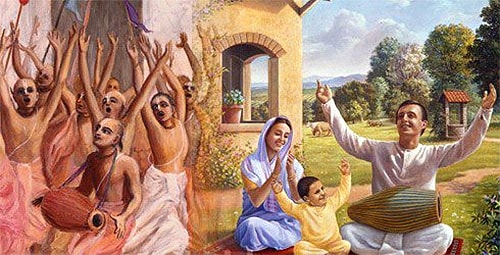 Srimad Bhagwatam(The Fifth Veda or The Mahapurana) talks about Nine forms of Bhakti. If they are cultivated and practiced regularly they will surely take us closer to God. A devotee can choose any of them to attain self realization. The following are the Nine ways involved in Bhakti Yoga:
- Shravanam(hearing of God’s names, divine plays and stories)
- Keertanam( chanting and singing of God’s glories)
- Smaranam(constant remembrance of divine name and divine presence)
- Paada sevanam(serving God’s feet)
- Archanam (worship of God)
- Vandanam(offering obeisance to God)
- Daasyam(serving God as its servant)
- Sakhyam(developing friendship with God)
- Atma nivedanam(total surrender of oneself to God)
A Bhakta or devotee can practice any of these whichever suits its nature.
Conclusion
 Love and devotion are regarded as the most noble virtues.
A man without love or devotion is similar to a fish without water or a bird without feathers or a plant without flowers. Bhakti yoga is a culmination of unalloyed love. It provides a way for channelizing one’s pure emotions towards one’s Chosen Ideal to reach our final goal of life: Self realization
Bhakti yoga is the easiest and perhaps the best way of realizing one’s true self for uniting with the divinity while living in this mortal world.
by digitalplus | Nov 5, 2017 | Yoga
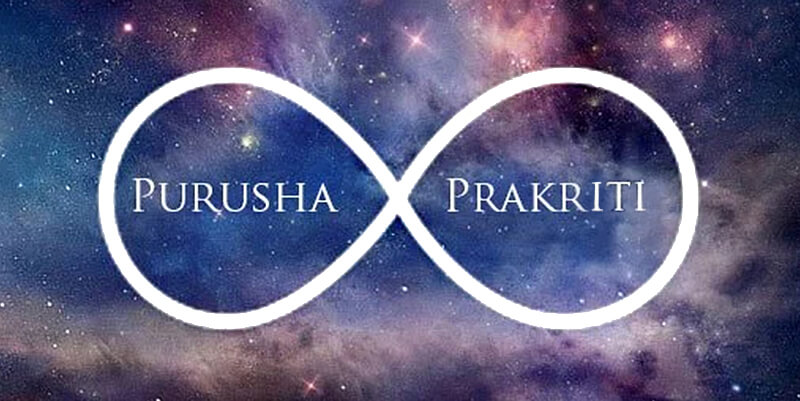
Purusha and prakriti are two abstract entities clearly defined in sankhya philosophy. It is quite similar to the yin and yang principles of Chinese philosophy. Sankhya philosophy is one of the six main schools of Indian philosophies also known as shad darshans. It is a dualistic and realistic philosophy which discusses the two main principles called purusha and prakriti in a detailed manner. Purusha and Prakriti are two basic, opposite, independent and eternal principles that are the main cause and reason behind the human existence. Purusha is a Sanskrit term which means spirit, person, self or consciousness in Indian philosophy. In Sankhya it means the principle of spirit or pure consciousness. It represents the male aspect of creation. Purusha is an inactive, unchangeable, universal and eternal entity. It is innumerable as there are human beings. Prakriti simply means nature. Prakriti is the principle of matter or substance. It is a non self without consciousness. Prakriti is active, changeable, earthly and eternal entity. It represents the female aspect of creation. The entire universe is created out of Prakriti or the fundamental matter. According to Sankhya the world is created as a result of the union between Purusha and Prakriti.
Sankhya in Brief
Sankhya is one of the oldest orthodox systems of Indian philosophy. It is founded by Sage Kapila. His work was originally known as Sankhyasutras.it contains six chapters and 526 sutras in all. A brilliant commentary was written on it by Vijyanabhikshu named Sankhya -Pravacana-Bhashya. It was further sustained and spread by Kapila’s disciple Asuri and his follower Panchashikha. The earliest reliable work on Sankhya that is available is called Sankhyakarikas by Isvarakrishna.it is also known as Sankhya Saptati. Many commententaries are wriiten on it like Sankhyakarika Bhashya of Gaudapada (A.D.700) and Sankhyatattva Kaumadi of Vachaspati(A.D.840).
Sankhya derives its name from Sankhya which means number, it mentions 25 ultimate principles in creation which justifies its name. It has been applied to Sankhya philosophy because it tries to find the right knowledge of reality by specifying the final objects of knowledge. Another meaning of Sankhya is jnana(samyak khyayate). It believes that jnana or right knowledge is the only means of liberation. Sankhya tries to know the knowledge of reality for ending all the pains and sufferings and attain liberation.It talks about the knowledge of the self which is clearly higher than what is mentioned in other philosophical systems except Vedanta. It is clearly characterized as the Sankhya in terms of pure metaphysical knowledge of the self. It is intellectual and theoretical in nature. It is a metaphysics of dualistic realism. It is dualistic because it speaks about only two types of ultimate realities namely purusha(spirit) and prakriti(matter). Sankhya shows an evident dualism between purusha and prakriti and further maintains the plurality of the purushas. It is silent on god. It is a pluralistic spiritualism and an aesthetic realism and rigid dualism. Sankhya is realistic as it believes that both the matter and spirit are equal and real. It is pluralistic also because it states that there are many purushas that coexist with prakriti in this world. Sankhya philosophy states that kaivalya or liberation from the birth-life-death-rebirth cycle as the final goal of human life. This liberation results in ultimate freedom for man from all the miseries and sufferings of human life. Sankhya says that that the main purpose of the evolution of the prakriti into this world is to give the purusha one more chance for liberation. The main cause of bondage of the purusha and his consequent suffering in the world is aviveka(ignorance, non- discrimination between himself as pure consciousness and prakriti which jada(the unconscious entity)it is this that is leading him from birth to death ,or from life to life again and again. Sankhya defines two kinds of liberation jivanmukti and videhamukti.
Jivanmukti is attained even while living here, the body continues to live for some more time, till the prabhdhakarmas(past deeds of previous lives)are exhausted. In this state the perfect being continues to live in the world, though not of the world.
Videhamukti means the final liberation that comes after the death of the body. Here the person will never come back to this material world. He will attain a perfect state free from all pain and suffering without bliss. However since chaitanya (consciousness) is his essence, he will always remain in his own state.
Aspects of Purusha (Consciousness) and Prakriti(Nature)
The Sankhya school of philosophy recognises two eternal principles called Purusha and Prakriti. The basic nature or Prakriti and the individual souls or Purusha coexist with one another. Purusha is eternal, something that does not create, uncreated, passive, absolute, infinite, pure, neither the cause nor the effect, consciousness and indestructible. Prakriti is eternal, uncreated something that creates, dynamic absolute, infinite, cause and active.
Sankhya states that a fine and subtle matter or principle is the basis of our physical existence.it is is called Prakriti or nature.it is the primal substance behind the universe.it is the material cause of the world, it is the first and foremost cause of all the gross and subtle objects. It is non self, incomprehensible and without consciousness.it gets affected and influenced by the Purusha(self or the spirit). It can only appear as the various objects of experience of the Purusha.
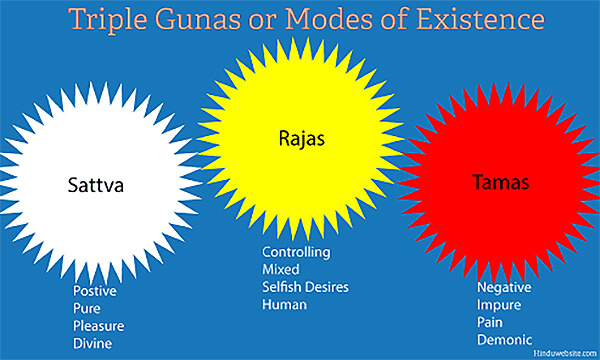
Prakriti is made up of three gunas, namely sattva, rajas and tamas. The term guna simply means quality or nature.but in sankhya philosophy it has a different meaning as a constituent (part or component). Sattva is associated with qualities like happiness, pleasure, compassion, being good, illuminating and constructive, rajas is associated with qualities like pain, suffering, chaos and impulsiveness; and tamas is associated with qualities like inactivity, lethargy, darkness, ignorance, destruction and negativity.
Sattva is the guna whose key elements are purity, fineness and subtlety. It is a constituent (part) related to lightness, brightness and pleasure. Sattva is associated with ego, mind and intelligence. Its connection with the consciousness is the strongest. Although sattva is the important condition for consciousness, consciousness forms the main basis of the purusha.
Rajas is the guna whose key elements are action, restlessness and passion.it is a constituent (part) related to actions of objects. Rajas is associated with activity and motion.in material things and objects motion and action are caused by rajas. In living beings activity, restlessness and pain are a result of rajas.
Tamas is the guna whose key elements are ignorance, dullness and inertia. It is a constituent(part)related to laziness and inaction.it opposes motion and activity in all material things and objects. In living beings it is associated with coarseness, negligence, carelessness, and inactivity. It is present in man as ignorance, insensitivity and inaction.
According to Sankhya, the effective cause of the world is Purusha and the material cause is the Prakriti. Here Purusha stands for “Supreme Spirit” and Prakriti stands for “Matter”. Purusha(spirit) is the first principle of sankhya. Prakriti(matter) is the second principle of Sankhya. Purusha is neither produced nor does it produce. Prakriti is not produced but it produces.
THEORY OF EVOLUTION ACCORDING TO SANKHYA
In ancient times the word Evolution (Parinama) was not used as in the modern sense. They saw it in a broad manner as not only as evolution of organic matter but atoms and consciousness also in connection with the soul.it was believed in olden times that the objective realty was not stable. Things changed from one form to another, within nature (prakriti) while it’s all-inclusive energy/matter remained stable. According to Sankhya nature is a blind force which is self-operating like a machine. All the causes and effects lie hidden in it. So it does not create anything new but brings out what is already present in it as a fixed program. Nature (prakriti) is both cause and effect. It is not created but creates. It is permanent but changeable. Things evolve in nature at the most basic and structural level with the elementary units called tattvas. Nature comes into action when it meets the purusha or individual soul. The changes in prakriti begins as it comes in contact with purusha. Their meeting causes the prakriti to become active and start evolving.
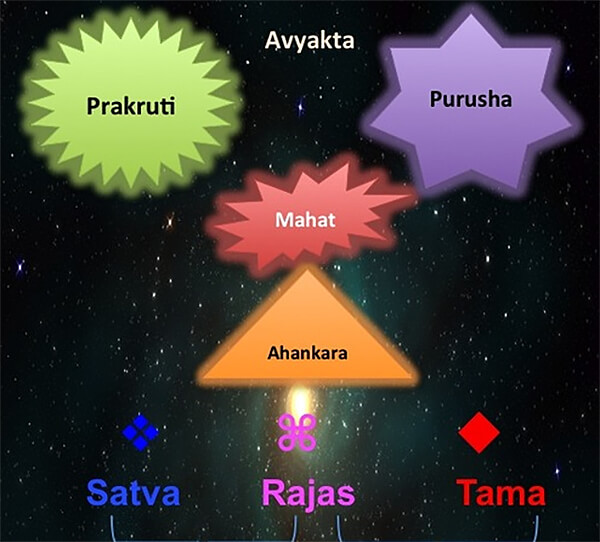
The creation or evolution of the world begins with the samyoga or effective contact of purusha(consciousness) and prakriti(matter).the totality of the karmas of the purushas disturbs the balance of gunas in prakriti and starts the process of evolution. So the first development with in nature upon contact with purusha is disbalance in the three qualities or gunas namely sattva(purity, dispassion and light),rajas(activity, passion and intensity)and tamas(inactivity, ignorance and darkness). As a result of the gunas mixing with one another, the first product of evolution of prakriti is mahat or buddhi( the cosmic intellect). It is the natural function of buddhi to manifest itself and other things. Buddhi is different from purusha or the self which goes beyond all physical things and qualities. But it is the base of all intellectual processes in all individual beings. After that the second product that arises directly out of mahat is called ahankara (cosmic ego, the principle of individuation). The function of ahankara is the feeling of “I and mine” (abhimana) it is because of ahankara that the self considers itself wrongly indeed to be an agent or a cause of action. A desirer of and striver for end and a feeling of ownership. There are three kinds of ahankara according to the predominance of one or the other three gunas.
The first one is called vaikarika or sattvika when the element of sattva predominates in it, second one is called taijasa or rajasa when the element of rajas predominates and the third one is called bhutadi or tamasa when the tamas element predominates. The sattva ahankara gives rise to the eleven organs, namely the five organs of perception (jnanendriya), the five organs of action (karmendriya), and the mind (manas). The tamasa ahankara gives rise to five subtle elements of earth, water, fire, air and ether (tanmatras). They further evolve into the five mahabhutas or gross elements (of earth, water, fire, air and ether). The rajas ahankara is involved in both the sattvika and tamasa ahankara, and supplies the energy needed for the change of sattva and tamas into their products.
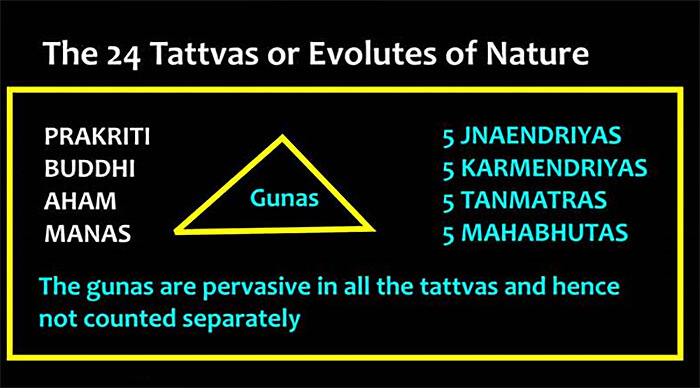
In all, including the prakriti , there will now be 24 cosmic principles or elements. The rest of creation takes place by their permutation and combination, each purusha getting involved with a psycho-physical complex(body)according to his deeds (karma). There are two stages of evolution namely the psychical and the physical. The history of the evolved universe is a play of twenty four principles, of which prakriti is the first, the five gross elements are the last, and the thirteen organs(karanas)and five tanmatras are the intermediate ones.
The 24 realities (tattvas) emerge or evolve out of nature (prakriti) each having the predominance of one or more gunas. The 24 tattvas or evolutes of nature are:
- Prakriti(Nature)
- Mahat(The Great Principle)
- Buddhi(Discriminating, Reasoning and Causative Intelligence)
- Ahankara(Ego or Ego Principle)
- Manas(The Physical mind or Brain)
- The Five Panchendriyas(Sense Organs)
- The Five Karmendriyas(the organs of action)
- The Five Tanmatras(Subtle Elements)
- The Five Mahabhutas (Gross elements namely the Earth, Water, Air, Fire and other)
For further reading and proper understanding go through the following texts:-
- Bhagwad Gita
- Samkhya Philosophy in details
- Shad Darshans(Six Philosophies of India)
by digitalplus | Oct 25, 2017 | Yoga
Yoga is a traditional and cultural science of India. It is nearly 5,000-10,000 years old. It is considered both as an art as well as science from the past till now. It is an ancient practice evolved by the sages of India. It consists of eight stages of development in a step by step manner. It effects all the physical, mental, social and spiritual aspects of our life. Yoga is a physical system with a spiritual basis.
“Yoga” or “Yog” is a Sanskrit word which derives its origin from the root word “Yuj”. It has two main meanings—union (yujyati) and concentration (samadhau). In the sense of union, it means to combine, connect or join together the individual soul with the universal soul. The second sense of concentration means complete control over one’s senses and reach the state of pure awareness(Samadhi). It is one of the six great philosophies (shad darshans) of India. It is an ancient system of philosophy, lifestyle and techniques that helps in evolving the whole personality of a person.
DEFINATIONS OF YOGA
The word ‘’Yoga is defined by various people in different ways. It refers to different things in present times.
 Ahirbudhyana samhita is an ancient scripture which defines yoga for the first time. It defines yoga as samyoga yoga itiyukto jivàtma paramãtmanah—Yoga is the union of the individual self (jivàtma) with the universal self (paramãtma).
A great sage Patanjali defines yoga as’’ yogaha chitta vritti nirodhah’’ which means the stoppage of all mental modifications. These modifications of the mind or chitta are called vrittis. In other words yoga is a mental discipline for keeping the fluctuations of thoughts under control, so that the consciousness (citta)is kept in a constant and stable state(stambha vritti).
In bhagwada geeta yoga is defined as samatvam yoga uchyate which means that yoga is a state of perfect balance or equanimity. A person practicing yoga remains at peace under all circumstances.
Yoga is also defined as yoga karmasu kaushalam which means yoga is skill in action. Yoga means union or integration of human personality.
BENEFITS OF YOGA ON OUR BODY
Regular practice of yoga brings about a complete transformation in our body .it helps in maintaining weight, makes our bones strong and lowers many ailments like heart disease, blood sugar level in diabetes, blood pressure and stress levels. It also improves our sense of balance , brain function, lung capacity and sexual functions. It provides relief in anxiety, reduces chronic neck and back pain. It also increases flexibility and changes gene expression.
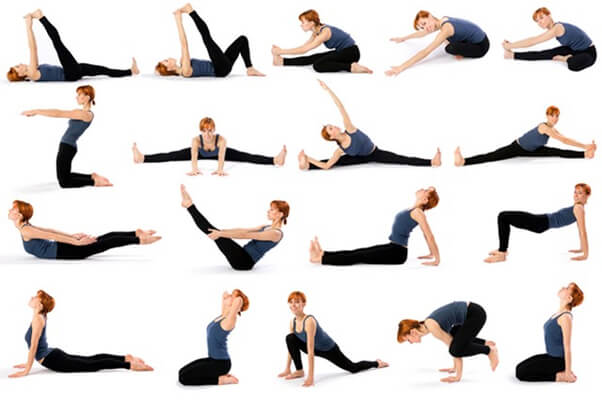
YOGA FOR HEALTH, WELLNESS AND STRESS MANAGEMENT
Health and wellness are two factors that are closely linked with the lifestyle of an individual. Yoga provides the main basis of perfect health and wellness due to its comprehensive and holistic nature. Principles of yoga help its practitioners to develop and improve their health and deal with all kinds of stress in an effective way. A new concept called yogic “health insurance” can also be achieved by changing our perception about stress, improving our reaction towards stress and dealing with repressed stress in an effective way. The practice of yoga helps in reducing stress by various relaxation techniques. The three main elements of an individual i.e., body, mind and breathe of an individual are improved by practicing yoga, as they are likely affected by stress. Prayer and meditation are two powerful techniques used for stress management and as an alternative medicine.
AIMS AND OBJECTIVES OF YOGA
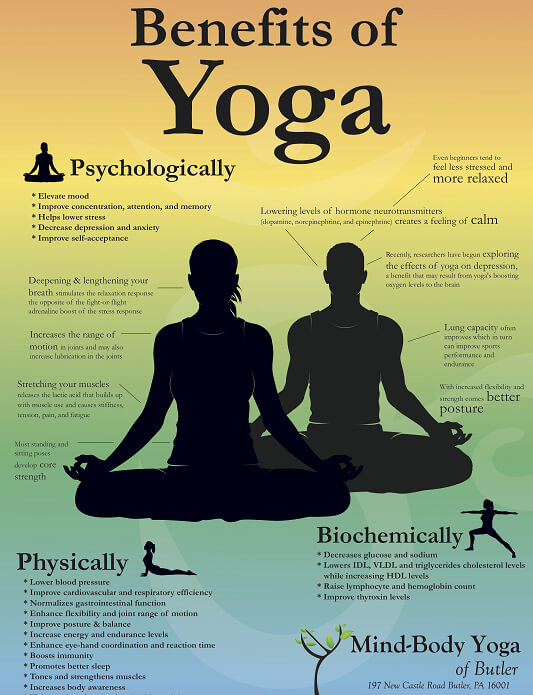 Yoga is the physical, mental, social and spiritual disciplined way of life. It is a way and view of life. Its philosophy and its practices aim at a balancing the different dimensions of human personality like mind, body and spirit. The main aim of yoga is to attain self-realization (moksha, kaivalya or nirvana) it is a state in which one is completely free from all miseries and sufferings of life. Yoga has many benefits in improving the overall quality of our life. The basic goal of yoga is gain balance and control in one’s life, to free oneself from all kinds of anxieties and stress and to provide a state of calmness. It comes from the regular practice of yogic asanas and pranayama or the breathing practices. The practice of yogic asanas help to overcome the limitations of the body. Yoga helps in reorienting and renewing the body both from inside and outside. It also relaxes the mind from all the ill effects of our modern life.
The different paths of yoga are based on different concepts and are reached by various methods. All of the different types of yoga lead to the same goal, that of self-realization. Our gross body which is the seat of the soul realizes its true identity by the practice of yoga.
Practice of yoga brings about a change in our life style and a complete transformation in our overall personality. It increases the longevity of our life.
The science of yoga is about training and transformation of mind and all other aspects of man. It helps the human being to go beyond the qualities of nature and experience perfect bliss.
The basic principle of yoga in our life is religious freedom and constant peace. Yoga is a universal dharma.
Yoga is not related to any particular religion. It is the cause of spirituality and timeless wisdom, the basis of all religions. Yoga is beyond all religions and shows the way to unity.
For more details on yoga kindly refer the following texts:-
- Patanjali Yoga Sutras
- Bhagwad Gita
- Hatha Yoga Pradipika
by digitalplus | Jun 15, 2017 | Yoga
Trataka or yogic practice of concentrated gazing is an ancient hatha yoga exercise used for all round development of our body, mind and soul. The meaning of word trataka is “to look fixedly” or “to stare pointedly”. The concept of trataka is defined clearly by some yogis and old yoga texts like hatha yoga pradipika. This is how hatha yoga pradipika defines it:
Nireekshaennischaladrsâ sukshmalakshya samâhita
Asrusampâtaparyantam âchâryaisrtâtakam smrtam
Being calm, a practitioner should gaze steadily at a small mark (a small thing), till eyes are filled with tears. This is called trataka by the âchâryas.
It comes under one of the shatkarmas or shatkriyas—six purification techniques in hatha yoga designed to make the body strong and healthy. It is an extremely powerful technique which helps us to cure and improve all eye disorders, removes laziness and controlling our mind. It actually aids in directing the nervous system in a definite direction and also increases our energy level. It quietens all our mental faculties and helps in attaining complete concentration and peace of mind.
Types of Trataka
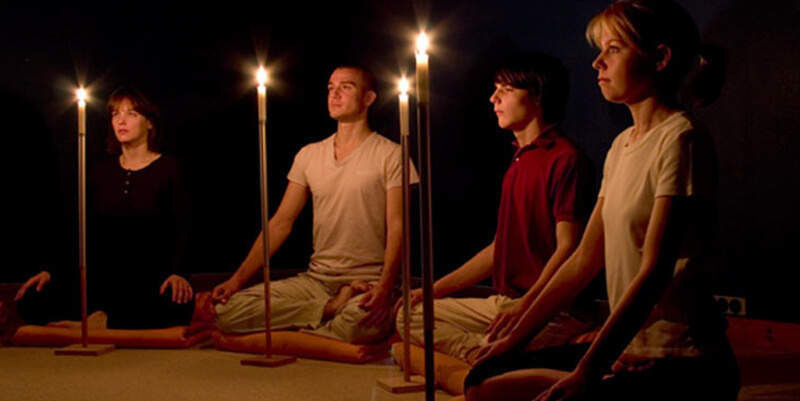
 Conventionally there are three kinds of trataka that can be practiced: Antar trataka, Madhya trataka and Bahya trataka.
Antar Trataka(Internal Gazing) : This is done with closed eyes and we have to imagine that we are gazing in the midpoint of our two eyebrows(bhrumadhya dhrishti), or heart, navel or any other internal organ.
Madhya Trataka(Centre Gazing) : In this exercise still gaze is fixed on centre of the eye(bhrumadhya)or tip of the nose(nasagra)or any nearby object made of any material. It can be practiced with aum written in paper, or concentric circles having a black dot in its middle, or a single black dot with open eyes.
Bahya Trataka(External Gazing) : It is performed by fixing our gaze on an distant object like rising sun, moon or a bright planet.
Practice of Trataka
Trataka is practiced by gazing at a fixed point or object without blinking the eyes. The main objective is to bring the mind into focus, and control its wavering tendencies thus making it single pointed and arouse the inner vision. All the thoughts and powers of mind are directed into an unbroken flow. It should be done in a relaxed way without any stress.after achieving this state the hidden potential and powers of mind are awakened naturally.
Technique of Trataka
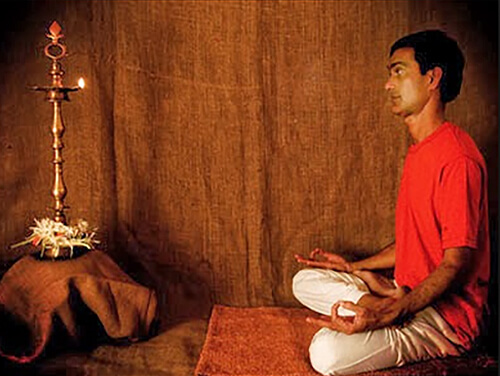
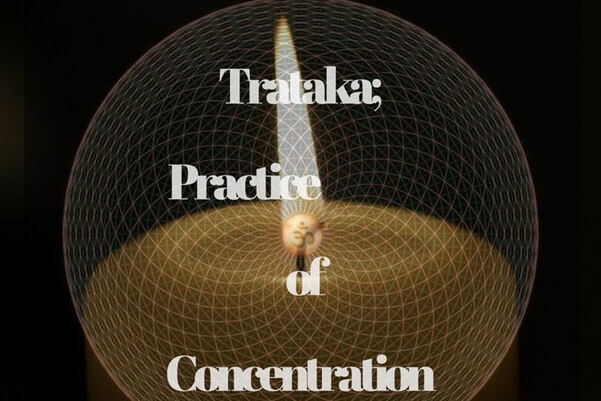 Trataka is practiced by sitting on ground in any of these postures like padmasana(lotus posture), ardha padmasana or sukhasana(comfortable sitting posture) keeping the spine and the back straight. A cow’s ghee lamp is placed at the same level of your eyes at a distance of one meter. Now keeping the mind relaxed one should look at the bright portion of the flame without blinking, till the tears start coming out of your eyes. This is the last phase of trataka. After doing this the eyes should be closed for a while and the practitioner should relax and sit quietly for 3-5 minutes and then slowly open his eyes. The exercise can be repeated 2 to 3 times. It is advised that after performing trataka one should wash his eyes and face with water. The time period of trataka from the beginning till the rolling down of tears differs from person to person. It also depends on the mental condition of the individual. The duration of trataka in normal individuals is generally 3-5 minutes and some people can extended the practice to longer periods.
Benefits of doing Trataka
Hatha yoga states that if trataka is done regularly ,it helps in curing all types of eye related problems and overcoming laziness.regular practice of trataka assists in the practice of shambhavi mudra which finally leads to a state of dharana(contemplation). The practitioner gets a great vision and intuitive insight.
According to Gherand Samhita a yogic text trataka helps in training and guiding the nervous system in a particular direction. It also aids in reducing and curing all kinds of mental tensions. It leads to a state of peacefulness and calmness. The sleep pattern is corrected within a small time with the practice of trataka. Its curing and improving tendency depends upon the mental and physical state of a person. It also assists in arising hypnotic powers and sixth sense if practiced regularly. Trataka acts as a means of advancement between physically oriented exercises and mental exercises which finally lead to higher awakening. It acts as a vital link between hatha yoga and raja yoga. Conventionally it comes under hatha yoga but it may also be considered as a part of raja yoga.
Physiology of Trataka
 Trataka is really helpful in removing all kinds of neural disorders and blockages and it also assists an individual in gaining deep concentration and meditation. The practice of trataka is very conducive in gaining control on our parasympathetic nervous system,lowering of heart rate and respiration rate. It also increases the amplitude of plthysmogram(vasodilation). It increases the peripheral blood circulation of our body. It aids in gaining complete mastery of our mind by eliminating all the emotional disturbances. All kinds of anxieties are removed by doing trataka regularly. Practicing trataka quietens our mental faculties and relaxes our mind by producing well modulated chain of alpha frequency. It is a process of purification. It acts as a catharsis or cleansing by eliminating all our repressed and suppressed emotions and desires from the subconscious level. The practitioner of trataka experiences great relaxation and state of calmness and peace at both physical and mental level.
Precautions
Avoid using candle or other lamps for doing trataka. Always use cow’s ghee lamp for practicing trataka for best results. Do not practice trataka on a flickering flame. Hypersensative persons should do trataka after doing shavasana. Emotionally and mentally disturbed people should do trataka only after practicing the basic postures(asanas) and processes(kriyas), never rub your eyes after doing trataka. Do not strain your eyes too much and do it as per your capacity. Do not read anything or watch television after doing trataka.