by digitalplus | Feb 13, 2018 | Yoga
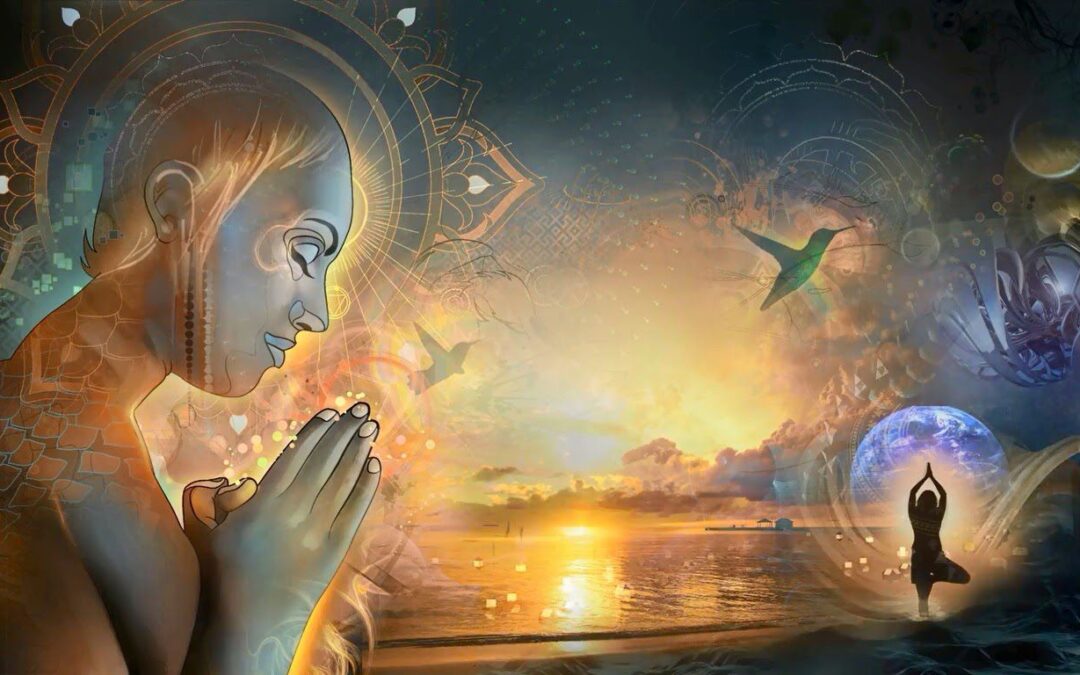
The word Bhakti is derived from a word ‘’bhaj’’ which means’’ to be attached to God’’.
Bhakti means a continuous, one directional and steady flow of pure love, devotion and adoration for one’s chosen Ideal (Ishtam) (The GODHEAD).The word Yoga is derived from a sanskrit word ‘’yuj’’ which means to combine, connect or join together. Yoga can be be defined as the union of the Jivatman (Individual Self or Finite )with the Paramatman(Universal Self or Infinite). The path of Bhakti or highest devotion is called Bhakti Yoga. It requires complete surrendering of one’s own self at the altar of one’s Chosen, Ideal/Ishtam.
Bhakti yoga is one of the paths for realizing one’s true identity or self realization. Bhakti is a deep and intense devotion for any SAGUNA(definite form) of one’s chosen Ideal/Godhead. There are a no of ways of reaching the ultimate reality. Karma Yoga, Jnana Yoga, Raja Yoga and Bhakti Yoga are the four main types of yoga for realizing one’s true self. Bhakti Yoga is the easiest and best way to reach the absolute reality in present times.Bhakti Yoga is the highest point of pure and intense love for one’s Ishtam(Chosen Ideal) .Bhakti yoga completely erases all the samskaras (mental impressions) related to our karmas (actions ). It also frees its followers from the chain of birth-life-death-rebirth cycle.
Bhakti : Its True Meaning
Sage Narada a devotee of lord Vishnu(his chosen ideal)defines Bhakti as:
- “Sa tvasmin parampremarupa”
Bhakti means true and unconditional love for one’s chosen ideal(God)without any personal desires or external reasons and conditions.
Bhakti is like nectar, which when one drinks ,leads to the experience of permanent bliss.
- “Yallabdhava puman sidhho bhavati amrito bhavati tripto bhavati”
After achieving Bhakti one reaches the state of perfection. The Bhakta(Devotee) attains immortality like God and all its desires are completely fulfilled. Through Bhakti or devotion a Bhakta goes beyond the worldly desires and bondage. It becomes a mere instrument in the hands of God. The Bhakta becomes free from the cycle of birth and death.
Ways of Realizing One’s Self through Bhakti Yoga
 Bhakti is not based on any conditional state of mind. It has no pre-conditions or pre-qualifications. There is no specific method or formula for Bhakti Yoga. The only condition required in Bhakti is to surrender all our actions at the feet of God and become egoless.
The path of Bhakti is particularly followed by people having a high emotional quotient. The Bhakta (devotee) is driven mainly by the power of pure love and sees one’s chosen ideal as an Incarnation of love. Prayer,Worship and Ritual are the primary means of Bhakti Yoga. The Bhakta(devotee) completely surrenders itself to it’s chosen ideal. The Bhakta directs and transforms its emotions into unconditional love and devotion. Chanting or Singing the praises of one’s chosen ideal is an important part of Bhakti Yoga. There are five main enemies of one ’s self viz anger, delusion, envy, pride and lust. They have to be given up completely for filling oneself with Bhakti or the extreme devotion towards one’s Chosen Ideal. As the crystals of sugar get dissolved in water and lose its identity completely so is the Bhakta who completely gives up his pride, ego, hatred, ill will and self identity for one’s chosen ideal.
Though Bhakti is endowed with God’s grace, yet it can be cultivated by constantly involving ourselves in various devotional practices. Bhakti brings us closer to God and its grace flows through us.
Types of Bhaktas and Some Famous Bhaktas
There are mainly four types of Bhaktas:
- Ârta (the distressed)
- Jijnâsu(the inquisitive)
- Arthârthee(the desirer of wealth)
- Jnâni(he, who is searching for knowledge of the Absolute)
Chaitanya Mahaprabhu, Kabir, Mira bai, Tulsidas, Raidas, Valmiki, Surdas, Narada,Narsingh Mehta and Bhakta Prahlad are some of the famous devotees of of Bhakti Yoga.All of them were completely filled by extreme love and devotion for their Chosen Ideal.
Navavidha Bhakti or Nine Modes of Bhakti or Devotion
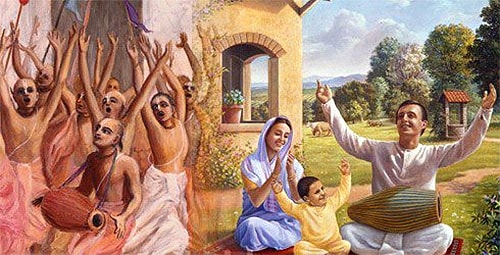 Srimad Bhagwatam(The Fifth Veda or The Mahapurana) talks about Nine forms of Bhakti. If they are cultivated and practiced regularly they will surely take us closer to God. A devotee can choose any of them to attain self realization. The following are the Nine ways involved in Bhakti Yoga:
- Shravanam(hearing of God’s names, divine plays and stories)
- Keertanam( chanting and singing of God’s glories)
- Smaranam(constant remembrance of divine name and divine presence)
- Paada sevanam(serving God’s feet)
- Archanam (worship of God)
- Vandanam(offering obeisance to God)
- Daasyam(serving God as its servant)
- Sakhyam(developing friendship with God)
- Atma nivedanam(total surrender of oneself to God)
A Bhakta or devotee can practice any of these whichever suits its nature.
Conclusion
 Love and devotion are regarded as the most noble virtues.
A man without love or devotion is similar to a fish without water or a bird without feathers or a plant without flowers. Bhakti yoga is a culmination of unalloyed love. It provides a way for channelizing one’s pure emotions towards one’s Chosen Ideal to reach our final goal of life: Self realization
Bhakti yoga is the easiest and perhaps the best way of realizing one’s true self for uniting with the divinity while living in this mortal world.

by digitalplus | Feb 9, 2018 | Food
Centuries back bread, cheese and wine was the staple diet in Britain, no wonder best wines , breads and cheese come from Europe; Brexit is a totally different concern but food that flows through the continent is divine, today food is something that satiate our Gourmet habits, we love enjoying good food but now the choice is not confined, we have outgrown ourselves, we enjoy food from around the world– as the world keeps getting smaller and globalization is the buzz, the International dishes are becoming common and readily available at times– being part of the global village we have seen different cuisines and we get crazy when allowed to relish several culinary outcomes but information is must to fix it all in the tummy.
 Let’s start with neighbouring nation Italy, the Pizza and Pasta is not all you get there, they have got varieties of food from Burrata (Panna Cotta), Bruschetta, Minestrone Soup (National soup of Italy), Risotto to end number of sauces like Pesto, Arabiata and breads, Ciabata, Focaccia, Garlic bread are some of the famous ones, that are revered by souls here: not to forget Tiramisu, literally means ‘Pick me up’ – when years back Prostitutes use to carry Tiramisu as a sign to ‘pick them up’ from those streets of Italy.
Mexican cuisine is another favourite here, let it be Chilli Con Carne (boiled kidney beans with minced tender lion cooked with Chipotle sauce), Burrito, Quesadillas, Nachos with Salsa or let it be Churros much loved with hot chocolate sauce. Mexican Chillies distinguish this Cuisine from others, Dried ancho, known as Pablano in it’s green avatar– this is King of Mexican Chillies, grown in Central Mexico , ancho has distinctively sweet taste with a tinge of coffee like bitterness to it– Jalapeno (most well-known and called Chipotle in it’s dried form) are some of the major chillies found here.
Chinese cuisine is the specialty, which is loved by many over here, they love Hakka noodles (as Chinese call ‘Hakka’ as ‘their guest’), Sichuan is another famous variety here which goes with both rice as well as noodles, Wontons come with end number of stuffing. Chinese were lactose-intolerant (not now, but centuries back they were, they couldn’t consume milk products, so you will not find any milk by-product in authentic Chinese cuisine, if you do then get cognisant that it is customized as per your needs, Chinese fled from motherland to overseas as it’s not easy to stay in the communist environment for long, the brainy ones revolted or bolted, so they took their cuisine with them, that gave popularity to Chinese food, but the tailor-made food it was, due to unavailability of raw-material or according to the taste of the local masses it was done in indigenous way and thus today somewhere we find sweet Chinese food like American Chopsey, at other places we find spicy Chinese food, so don’t wonder guys it is all in the history.
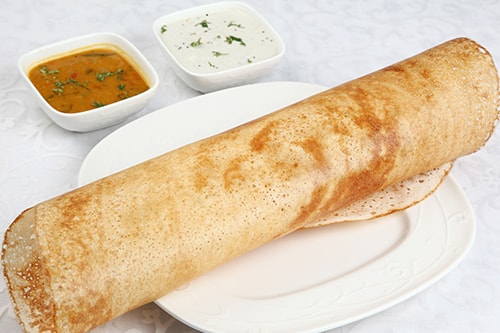 Indian cuisine is another classical cuisine coming from one of the oldest civilization, food here is diverse as the sub- continent itself is, all the famous Indian breads like the Naan, Tandoori Roti and tandoor(open-oven) done food like Chicken Tikka, Tandoori Chicken, Seekh Kebab are well-regarded here. Chicken Tikka Masala is England’s most popular Indian dish, Butter Chicken, Rogan Josh, Palak Paneer, Chaat all comes from Northern region, while Dosa (pancake), Sambhar (vegetable stew) comes from down-south, you get massive Gujarati food in the west like Dhokla, Undhiyu, Gujrati kadi and so on.
Now, Japanese cuisine is quite prevalent in today’s world, sushi/ sashimi, Miso soup are some of the famous foods in this cuisine. Their specialty is Hitachi and Tapenyaki concepts of cooking, these are the live grill cooking techniques used in this cuisine. People enjoy food from this kind of cooking which is unique in its own way.
Arab is another one of the oldest civilization, so is the Cuisine , over here you get Pita bread with Hummus, that is quite famous, Khubz (Arabic flat bread quite like the Pita that you will find throughout the region, wherever you go), Kefta (grilled dish of ground meat like lamb or beef), Arabic tea and coffee (Al Qahawa or the Arabic coffee is a ritual in itself. It is usually made with the addition of some cardamom, served in small cups without handles and always with dates. If you are eating in a restaurant, it is always served complimentary with the meal) even Shwarma is something that is loved by everyone around.
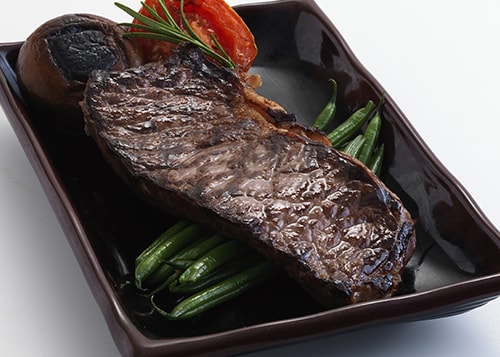 European Grills are wonderful in themselves, Char grilled octopus, Grilled scallops in olive and garlic, Beef steaks, Pork steaks, Lamb steaks, Grilled prawns are some of the famous ones, for vegetarians as well you have pineapple, that is grilled in open fire, grilled potatoes, mushrooms, tofu, cottage cheese are some of the finest grills available in the market.
If we talk about patisserie, French has already touched the Zenith, they are proud owners of world’s best bakery products and when it comes to desserts, then they are truly die for, let it be Crème Brule commonly known as Caramel Custard, Éclairs, Opera Cake, Tarte tatin, Chocolate mousse, Mango Bavarian, Lemon soufflé and many more which are truly marvelous.
But Food talk is incomplete until and unless Connoisseur meets the Sommelier, i.e., food-wine harmony, which wine goes with what food; like, with Fish fingers or other anti-pasti course basically white wine like Chardonnay & Chablis or light bodied red wine will go, but when talk about Beef steak that’s quite heavy, so we require strong red wine like Shiraz or Cabernet Sauvignon, again with Desserts we require sweet wine so that we can savor taste of both wine as well as food, so one can try Riesling (real sweet wine) that will really settle your palate.
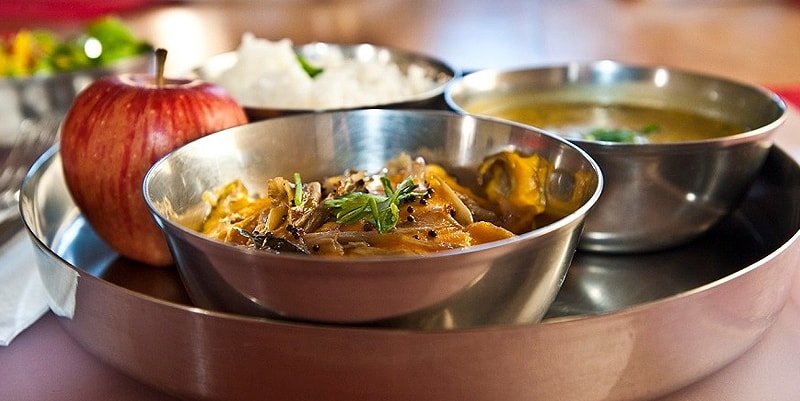
So much food! Isn’t it? I can’t resist any more so creating an appropriate meal for myself, not French classical menu but of course I am starting with an antipasti course, i.e., Chicken tikka and Sushi with garlic, Soya sauce and Wasabi followed by a Soup course, Consommé soup with vegetable juliennes as it is building my appetite to go forward, I love fish so going for Ginger soy steamed fish accompanied with Chardonnay white wine, now I am placing shwarma in my plate wrapped with Pita bread. For main course Penne Pasta with Arabiata sauce, followed with some beef steaks, with Shiraz red wine, for desserts Caramel custard and Tiramisu, as I have sweet tooth, so eating a slice of Opera cake followed by a shot of Americano and as I can see here my platter looks fantastic, now it’s your turn guys, see how the World Food looks in your Plate and you can try whatever you feel like because Food is Gourmand’s Utopia. Wish you all “Bon Appetit”.
by digitalplus | Feb 1, 2018 | Food
Food is a basic necessity and plays a vital role in building the entire Personality of an individual. All our physical strength, mental faculties and spiritual leaning is a sum and substance of the food that we eat. Our mind and feelings are shaped by what we consume. In recent times lots of diseases and health problems have increased due to our indiscriminate eating habits. The fast pace of the modern times has changed the entire food patterns of all and sundry. The old dictum of “Eat fresh and healthy and Stay wealthy” is slowly waning and is replaced by the modern spectre of fast food. Modern fast food and various unhealthy food habits have completely changed the dynamics of general Health and lifestyle of an individual. Several deadly diseases like various types of Cancer and Health issues like Obesity are on the rise. All these Health issues and other problems related to wrong eating practices can be solved by taking recourse to the Yogic food or Diet. The concept of Yogic food is becoming the order of the day in the present times owing to its salutary effects on our Body, Mind and Soul.
What is Yogic Food?
 Any food that has a salutary and wholesome effect on our Body, Mind and Soul and transforms our whole being is called Yogic food. It is very helpful for both our Worldly and Spiritual progress. Yogic food is based on the ancient Ayurvedic and Yoga principles that were enunciated by the Indian Yogis of yore. Both Yoga and Ayurveda consider food as an indispensable component of our life. The Ancient yogis consider the Yogic food as Brahman (The Ultimate Reality underlying all phenomenon in Hindu scriptures) and the bedrock of our existence. They also believe that from food all beings are born, by food they live and into food they return.
Yogic food helps us to evolve both internally as well as externally. It is a Balanced diet which impacts not only our Physical health and thoughts but also our emotional and spiritual well being. It is also hailed as Lacto-vegetarian food. It consists of grains, pulses, fruits, vegetables, legumes, nuts and seeds along with milk products and honey. It totally excludes all the animal foods and eggs too. Yogic food is simple, natural and wholesome and it also considers the subtle effect of food on our mind and prana(life force or breath).
Yogic food dwells on the type and the quality of food to be consumed in details. It also points out clearly the type of foods to be avoided. It lays emphasis on the nourishment that we acquire from various sources of food and not on its flavour. Yogic food lays a great stress on the principle of moderation on anything that we eat or drink. Yogic food plays an important role in all round development of our body, mind and soul
Importance of Yogic food
There are four types of Yogic food:-
- To be chewed
- To be sucked
- To be licked
- To be drunk
When these four types of food are eaten by an individual, they get converted into Rasa and it is further divided into three parts:-
- The most vital part of this Rasa acts as a nourishment for our subtle body which includes the mind, intellect, ego etc
- The second or the middle part nurtures the Seven Dhatus(seven tissues) of our body
- The third and the last part is actually a Waste material. It is excreted out of our body through various means like carbon dioxide is thrown away by the lungs, sweat from skin, urine and stool from their respective organs.
Yogic food lays emphasis on three main principles:-
- Hitbhuk – One should always eat the proper type of food that is wholesome for our body, mind and soul. It stresses on the fact that we should always eat what is healthy and good for us. We should not become a slave of our taste buds and eat all types of food. We should choose such food items which increase our longevity and help in our overall development.
- Ritbhuk – One should always eat according to the prevailing season and it should be earned through righteous and honest means. Then only it will be beneficial for our body, mind and soul. It lays importance on the fact that whatever we eat should be obtained from ethical and pure means. The food should be prepared and eaten with purity of mind. The one who prepares the food should be kind and affectionate and the one who eats it should eat it by first praying to God. It also stresses that the food that we consume should be in accordance with the existing season.
- Mitbhuk – One should always eat in moderation that has a salutary effect on our body, mind and soul. It recommends a moderate quantity of everything one eats and drinks. Self-discipline in choice of food is important not only for our health but also for our spiritual evolution. It strictly prohibits overeating and overindulgence of any kind. It stresses the fact we should eat only eat those foods which are conducive for our health and avoid tasty and unwholesome food.
 Yogic food comprises of a moderate diet which satisfies three- fourths of one’s hunger with food offered to God, one-fourth part should be kept empty. It is known as Mithara, the limited food or balanced diet.
Food is classified on the basis of Tri-gunas and is of the following three types namely Sattvika, Rajasika and Tamasika. Yogic food strictly advocates Sattvika food and strictly prohibits Rajasika and Tamasika food completely.
Sattvika food is one which increases vitality, energy, vigour, health, joy and mirthfulness. It is savoury oleaginous and wholesome. It helps in overall growth and development of body, mind and soul.
Rajasika food is bitter, sour, saline, hot, pungent, dry and burning. They stimulate the body and mind and lead to pain grief and disease as an outcome.
Tamasika food is stale, tasteless, stinking, cooked overnight, refused and impure. It leads to lethargy, restlessness and inertia as its end result.
Yogic food follows the Sanskrit Sutra completely:-
“Yuktahara-viharasya yukta –cestasya karmasu
Yukta-svapnavabodhasya yogo bhavati duhkha-ha”
One who is moderate in his habits of eating, sleeping, working and recreation can overcome all worldly pains and sorrows by practicing Yoga.
Everything that we consume acts as a food for our soul. The food that we eat has a close relation with our mind. Whenever we eat anything it becomes trebled, the gross particles become excrement, the middle particles become flesh and the finest particles become the mind. Therefore whenever we consume food the fine particles that rise upwards form the mind. Hence truly the mind is the food.
 The Yogis believe that food gives rise to the prana(life force)that helps in maintaining our bodies and also gives us vitality and health. Thereby, the types of food that we choose to eat show the true measure of our conscious development. Yoga strongly recommends a pure and moral vegetarian diet, which helps in the evolution of Sattva guna. Sattva is the quality of love, understanding, relation and peace with all living beings.
The Yogis are of the view that food acts as the first interaction with the world surrounding us. If we do not eat with a feeling of love, relation and peace, then all other aspects of our life are bound to get affected. Sattva is based on the concept of ahimsa (non injury). A Sattvik food avoid all those foods that are involved with the killing or harming of animals. Sattvik foods also includes the foods grown in harmony with nature. It also includes ripened and natural foods.
In addition to it the foods that we consume should be prepared with love and positive feelings. Yogic food helps in increasing the prana and higher state of consciousness.
Yogic food surely provides a means for improving and enhancing our overall health and well being. It acts as a Prophylactic means to save us from the onslaught of deadly diseases and acts a “panacea for all ills” for sure. Evolution is better than Revolution. Let us gradually embrace this sublime concept laid down by the Ancient Indian Yogis and completely transform our Whole being.
by digitalplus | Jan 19, 2018 | Travel
India is a Spiritual land dotted with many holy places famous for their divine aura. It’s a version of Mini world in itself. It’s known all over the world as a land of all major Religions and its unique Culture and Philosophy. Scores of people around the globe visit India round the year to replenish themselves with its holy vibes.
India is full of many Spiritual jewels which are known for its unique vibes and divine ambience. Rishikesh is one of the Spiritual jewels of India. Rishikesh is truly a divine place which has so much to offer for any wanderlust. It is rightly hailed as the Yoga Capital of the World owing to its divine vibes. It has got everything to attract all kinds of globetrotters.
It is a perfect tourist spot for one and all. Yoga and Spirituality are its prime attractions for everyone across the globe. Rishikesh is the Entryway to the Himalayas in the Tehri Garhwal region of Uttarakhand. It is truly blessed by Nature with many divine gifts. The Great Himalayas and the Holy Ganges add beauty to its grandeur. It’s a magnificent place brimming with a unique sacred aura to elevate your dampened spirits. A divine tour to Rishikesh will surely rejuvenate your senses.
We have cherry-picked our top 10 places for you that are worth visiting in Holy Rishikesh. They are:
 Laxman Jhula and Ram Jhula: The Twin Swinging pivots of Rishikesh.
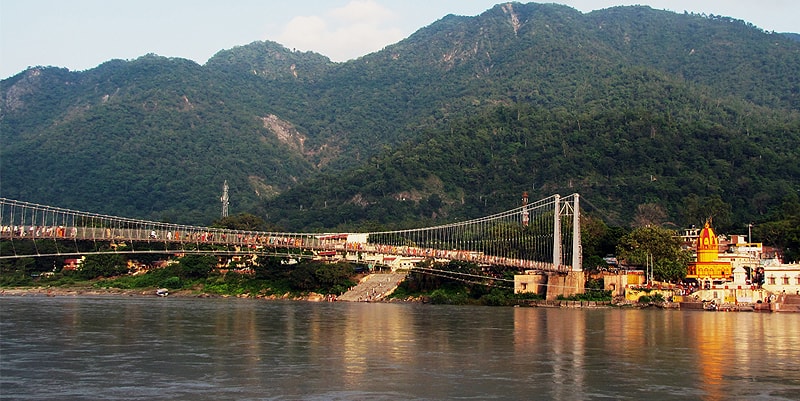
Laxman Jhula and Ram Jhula are the crowning glory of Rishikesh. They are situated at a distance of 4 kms from the Railway Station. These two majestic architectural wonders offer a picturesque view of Rishikesh and are one of the top pilgrimage spots. They are long iron suspended bridges that connects the two banks of river Ganga. Laxman Jhula is a 450 feet long and 70 feet high bridge which links the two villages, Tapovan in Tehri Garhwal District and Jonk in Pauri Garhwal District spanning the river from west to east. It offers a magnificent view of Rishikesh. It owes its name to Laxman, the younger brother of Lord Rama and a great mythological figure of Ramayana.
Ram Jhula is the longer between the two bridges. It acts as a link between Sivananda Nagar of Muni Ki Reti in Tehri Garhwal District to Swargashram in Pauri Garhwal District, spanning from west to east. It presents a divine view of the holy Ganges and scores of holy temples situated on its banks. It owes its name to Lord Ramayana incarnation of God and the key figure of Ramayana. Both these bridges are emblematic landmarks of Rishikesh .
 Triveni Ghat: It is one of the holiest river banks of Rishikesh. The word Triveni signifies the confluence of the three holy rivers namely the Ganges, Yamuna and Saraswati. It is usually crowded by scores of people owing to its sacred significance. Its holy ambience reaches a different level during the evening Ganga Aarti. It’s truly a divine sight to behold and tap its holy vibes during the ancient divine ritual of “Ganga Aarti”.The sacred aura and spiritual beauty of this place is truly awesome. It is said that taking a holy dip in it washes away all our sins and refines our heart and soul. A must visit place for sure.
 Shivananda Ashram: The glory of Rishikesh is incomplete without mentioning the Divine Saint named Swami Sivananda. Swami Sivananda was instrumental in giving a timeless gift of spirituality to Rishikesh by his graceful presence and austerity. He was a Spiritual Giant who founded the Divine Life Society in 1936. It carries out various educational, cultural and spiritual activities for the Human advancement. Sivananda Ashram is dedicated to this great Saint and divine personality. The exterior view of the Ashram is known for its scenic beauty, verdant surroundings and ravishing view of the Ganges. Its interior is also famous for its riveting and holy ambience. It has many beautiful temples, meditation spots and small cottages which are worth visiting.
 Beatles Cottage or Ashram: The Maharishi Mahesh Yogi Ashram shot to fame after the famous musical group of Beatles visited this quiescent place in 1968. It changed its name from Maharishi Mahesh Yogi Ashram to Beatles Cottage or Ashram. It is one of the symbolic attractions in Rishikesh. Its serene and calm ambience will soothe your senses for sure. It’s a divine spot with a magnetic aura to rivet your attention .It’s one of the most visited places owing to its divine vibes. A brief session of meditation at this place will surely rejuvenate your spirits. Its quaintness is too good to miss really.
 Neelkantha Mahadeva Temple: Neelkantha Mahadeva Temple is the divine dwelling of Lord Shiva. The name Neelkantha draws its analogy from a legendary tale of Samudramanthan(Churning of ocean). Neelkantha signifies the blue throat of Lord Shiva when he drank the poison named “Halahal” during the Samudramanthan.(churning of Ocean).It is one of the holiest shrines and religious spot dedicated to Lord Shiva. It is situated at a distance of 32kms from Rishikesh at an altitude of 1675metres. It is known for its sacred vibes and divine aura. It is really famous for the legend of Samudramanthan which is illustrated in its inner side of Tomb. A freshwater Spring situated in the Temple is also a key attraction of this divine place. Lots of devotees take bath in it. It is one of the most visited places of Rishikesh. A must visit for all seekers of divinity.
 Parmartha Niketan: It is one of the most famous Ashrams situated on the banks of the holy Ganges in Rishikesh. It was founded by Revered Swami Shukdevananda Ji. It is the largest Ashram in Rishikesh with a capacity of more than 1000 rooms. It is located in the lap of Himalayas and is well known for its calm, wholesome and divine ambience. It is one of the best places to stay for the tourists. It has all the basic amenities for every kind of visitor across the Globe. Lot of people visit this great Ashram throughout the year. It carries out a host of activities related to Vedic Education, Yoga and Spirituality. It’s renowned worldwide for its Hawan and Ganga Aarti performed on the banks of the Holy Ganges. The Ganga Aarti is performed twice a day in the morning and evening. It attracts lot of devotees and visitors because of its divine aura and holy vibes. Ganga Aarti confers its nearby surroundings with its holy Grace. Parmartha Niketan is world famous for its International Yoga Festival which is held every year.
-
 Jumpin Heights: Rishikesh is truly a paradise for all Adventure lovers. There are a number of Adventure spots in Rishikesh which attract a large number of tourists throughout the year. Jumpin Heights is surely one of them. It has got a large number of choices for all Adventure seekers.You will surely experience an adrenaline rush at this marvelous adventure destination. There are a plenty of options available for you at Jumpin Heights like Bungee Jumping, Flying Fox, Giant Swings and lots more. The Team of Experts is always available at Jumpin Heights to assist you. A must visit adventure spot.
 Swarga Ashram: Swarga Ashram is one of the oldest Yoga Ashrams in India well known for its divine vibes and serene ambience. It lies between the Twin swinging bridges of Ram Jhula and Laxman Jhula. It is one of the major tourist attractions for different people across the globe and is a perfect spot to soothe your senses. It is built in the loving memory of Swami Vishudhananda. Unlike the other Ashrams which are bubbling with activity this Ashram radiates a divine aura and is known for its tranquility. It offers you a respite from the hustle and bustle of daily life. It is a perfect place for Meditation and filling ourselves with Spirituality .You should also behold the charm of the Sunrise and Sunset of this divine spot and enjoy its Natural setting.
 Kaudiyala : It is a small Village situated at a distance of about 40kms from Rishikesh. It’s a famous Rafting spot and a must visit place for all Adventure lovers. It’s a well-known White water Rafting spot in the entire world. All the White water Rafting in Rishikesh is centered in and around Kaudiyala and its banks. It is always teeming with lots of Adventure seekers throughout the year. Lots of tourists also come here for Boating and Camping by river. It is also famous as a Biodiversity spot and offers a perfect sight for Bird lovers too. Apart from Trekking and Rafting classes it is quite famous for Rock Climbing also. A must visit for complete Adventure and pleasure.
 Bharat Mandir : It is one of the holiest and oldest Temples of Lord Hrishikesh Narayan in India. According to mythology it is as old as Rishikesh! Located in the heart of Rishikesh, it is also one of the most visited tourist spots in Rishikesh. The great Spiritual Master Jagadguru Adi Shankaracharya re-established the idol of its presiding deity on the eve of Basant Panchmi in 789 A.D. Every year on the eve of Basant Panchmi a figurative reinstallation is carried out. It is truly a divine temple known for its sacred ambience. Bharat temple is mentioned in many Hindu scripts and epics like Mahabharat, Vishnu Puran and Srimad Bhagwad. According to the legends it is believed that the one who perambulates 108 times around it on Akshya Tritya, and seek the blessings of Lord’s uncovered feet will be truly graced by Lord himself. All his wishes will be fulfilled. It has the same significance as that of the holy pilgrimage of Badrinath. There are many old trees in the premises of Bharat Mandir, the verdant surroundings of these old trees will surely calm your senses. The three main trees namely Vat (Banyan tree), Pipal (Bodhi tree) and Bel (Bengal Quince)represents the Trinity of Brahma, Vishnu and Mahesh. The Bharat Mandir Museum is a centre of attraction for many historians and archaeologists. It displays various sculptures, pottery and embellished bricks found during excavation. A must visit Temple.

by digitalplus | Jan 14, 2018 | Technology
Technology has become the buzzword of the modern world. It has become the order of the day in recent times. Technology has covered almost all spheres of our lives. Restaurant Industry is no exception and has benefited largely with the advent of technology. The entire Dining experience has undergone a paradigm shift with the influx of technology. The dynamics of both the Customer and the Restaurateur has changed drastically.
There are a number of ways in which the Technology boom has completely turnaround the Restaurant Industry. We have picked the top 5 Technological innovations for giving a fillip to any Restaurant. These are indispensable for any Restaurant who wants to dip their toes in the Ocean of Digital Marketing and Technology.
 Booking System: The Online Booking and Sales has given an impetus to the Restaurant industry.it has helped both the Customers as well as the Restaurateurs by easing the process using Technology. With just a few clicks you can now book your table as per your convenience. The Online Booking system has proved quite handy for a Customer. It saves their time due to quick response time. Earlier the Customers had to visit the Restaurant physically for booking their table. It was too tedious and time consuming. The Online Booking has helped the restaurateur by making it quicker and precise. It has also helped them in better Capacity Management.Thanks to the Technology which has made it so easy and simple.
- Feedback Management System: It has provided an effective means to the Restaurateur to gauge their quality of meals and services. It is set in motion by receiving online inputs from the customers.
The Online Feedback System provides a real time feedback to the Restaurateur. It helps them to analyse and evaluate all their operations. It acts as a Management Information System. It improves their efficiency and they are able to deliver their best to their clients. The Customers are also benefitted by the Online Feedback System. The Online System speeds up the response time and all their complaints and suggestions are entertained quickly. It has led to a better Dining experience with every feedback received. In earlier times the feedback given by a Customer was through pen and paper which was cumbersome for them as well as the Restaurateur.
- Digital Loyalty Programme: It is one of the best ways to increase and retain the Customer base for the Restaurant industry. It gives immense benefits to the customers too by giving them attractive offers and various benefits. The program helps to tailor, make promotions for each customer base during their special days and occasions like birthday, anniversary, small weddings, reunions etc. It has gained currency in the recent times and has helped the Restaurant Industry to hold on their customers. It is a cost effective and technology helps to analyse, evaluate the effectiveness of each activity.

- Promotional Text Messaging: It is one of the most convenient and quick ways to connect to your Customers. Text messages can be used to send various coupons and promotions to increase your business. It is really a cost effective means for Marketing and Advertising. It also helps in enhancing revenue and accruing other benefits.
- Social Wi fi: Guest Wi-Fi has become an important and “must have” feature for every Restaurant in recent times. It helps all the restaurant goers to access “free Wi-Fi”. It also benefits the Restaurateurs by having an access to all the social activities of their Customers during their Dining experience. Technology assists in acquiring the customer records too, with simple analytics which helps in future customer communication.
by digitalplus | Nov 5, 2017 | Yoga
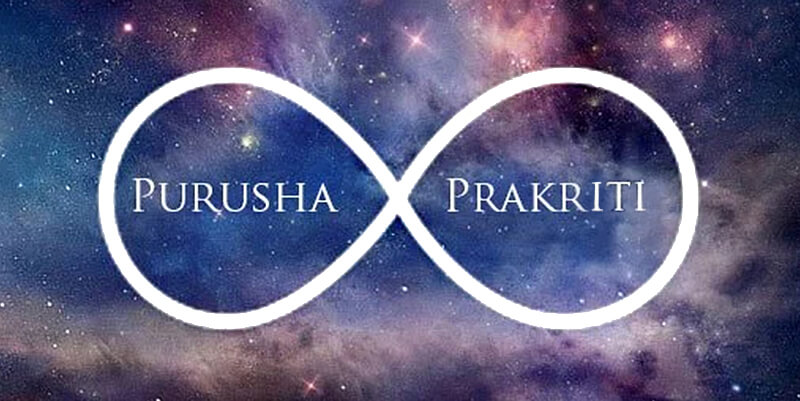
Purusha and prakriti are two abstract entities clearly defined in sankhya philosophy. It is quite similar to the yin and yang principles of Chinese philosophy. Sankhya philosophy is one of the six main schools of Indian philosophies also known as shad darshans. It is a dualistic and realistic philosophy which discusses the two main principles called purusha and prakriti in a detailed manner. Purusha and Prakriti are two basic, opposite, independent and eternal principles that are the main cause and reason behind the human existence. Purusha is a Sanskrit term which means spirit, person, self or consciousness in Indian philosophy. In Sankhya it means the principle of spirit or pure consciousness. It represents the male aspect of creation. Purusha is an inactive, unchangeable, universal and eternal entity. It is innumerable as there are human beings. Prakriti simply means nature. Prakriti is the principle of matter or substance. It is a non self without consciousness. Prakriti is active, changeable, earthly and eternal entity. It represents the female aspect of creation. The entire universe is created out of Prakriti or the fundamental matter. According to Sankhya the world is created as a result of the union between Purusha and Prakriti.
Sankhya in Brief
Sankhya is one of the oldest orthodox systems of Indian philosophy. It is founded by Sage Kapila. His work was originally known as Sankhyasutras.it contains six chapters and 526 sutras in all. A brilliant commentary was written on it by Vijyanabhikshu named Sankhya -Pravacana-Bhashya. It was further sustained and spread by Kapila’s disciple Asuri and his follower Panchashikha. The earliest reliable work on Sankhya that is available is called Sankhyakarikas by Isvarakrishna.it is also known as Sankhya Saptati. Many commententaries are wriiten on it like Sankhyakarika Bhashya of Gaudapada (A.D.700) and Sankhyatattva Kaumadi of Vachaspati(A.D.840).
Sankhya derives its name from Sankhya which means number, it mentions 25 ultimate principles in creation which justifies its name. It has been applied to Sankhya philosophy because it tries to find the right knowledge of reality by specifying the final objects of knowledge. Another meaning of Sankhya is jnana(samyak khyayate). It believes that jnana or right knowledge is the only means of liberation. Sankhya tries to know the knowledge of reality for ending all the pains and sufferings and attain liberation.It talks about the knowledge of the self which is clearly higher than what is mentioned in other philosophical systems except Vedanta. It is clearly characterized as the Sankhya in terms of pure metaphysical knowledge of the self. It is intellectual and theoretical in nature. It is a metaphysics of dualistic realism. It is dualistic because it speaks about only two types of ultimate realities namely purusha(spirit) and prakriti(matter). Sankhya shows an evident dualism between purusha and prakriti and further maintains the plurality of the purushas. It is silent on god. It is a pluralistic spiritualism and an aesthetic realism and rigid dualism. Sankhya is realistic as it believes that both the matter and spirit are equal and real. It is pluralistic also because it states that there are many purushas that coexist with prakriti in this world. Sankhya philosophy states that kaivalya or liberation from the birth-life-death-rebirth cycle as the final goal of human life. This liberation results in ultimate freedom for man from all the miseries and sufferings of human life. Sankhya says that that the main purpose of the evolution of the prakriti into this world is to give the purusha one more chance for liberation. The main cause of bondage of the purusha and his consequent suffering in the world is aviveka(ignorance, non- discrimination between himself as pure consciousness and prakriti which jada(the unconscious entity)it is this that is leading him from birth to death ,or from life to life again and again. Sankhya defines two kinds of liberation jivanmukti and videhamukti.
Jivanmukti is attained even while living here, the body continues to live for some more time, till the prabhdhakarmas(past deeds of previous lives)are exhausted. In this state the perfect being continues to live in the world, though not of the world.
Videhamukti means the final liberation that comes after the death of the body. Here the person will never come back to this material world. He will attain a perfect state free from all pain and suffering without bliss. However since chaitanya (consciousness) is his essence, he will always remain in his own state.
Aspects of Purusha (Consciousness) and Prakriti(Nature)
The Sankhya school of philosophy recognises two eternal principles called Purusha and Prakriti. The basic nature or Prakriti and the individual souls or Purusha coexist with one another. Purusha is eternal, something that does not create, uncreated, passive, absolute, infinite, pure, neither the cause nor the effect, consciousness and indestructible. Prakriti is eternal, uncreated something that creates, dynamic absolute, infinite, cause and active.
Sankhya states that a fine and subtle matter or principle is the basis of our physical existence.it is is called Prakriti or nature.it is the primal substance behind the universe.it is the material cause of the world, it is the first and foremost cause of all the gross and subtle objects. It is non self, incomprehensible and without consciousness.it gets affected and influenced by the Purusha(self or the spirit). It can only appear as the various objects of experience of the Purusha.
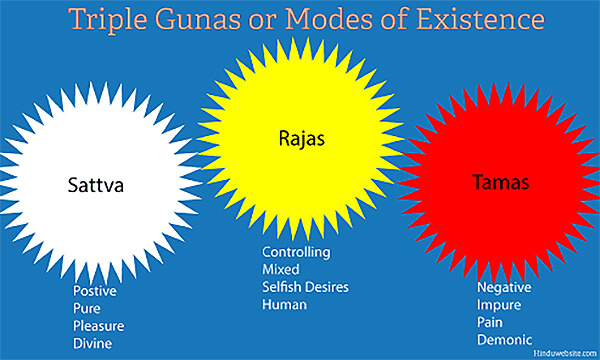
Prakriti is made up of three gunas, namely sattva, rajas and tamas. The term guna simply means quality or nature.but in sankhya philosophy it has a different meaning as a constituent (part or component). Sattva is associated with qualities like happiness, pleasure, compassion, being good, illuminating and constructive, rajas is associated with qualities like pain, suffering, chaos and impulsiveness; and tamas is associated with qualities like inactivity, lethargy, darkness, ignorance, destruction and negativity.
Sattva is the guna whose key elements are purity, fineness and subtlety. It is a constituent (part) related to lightness, brightness and pleasure. Sattva is associated with ego, mind and intelligence. Its connection with the consciousness is the strongest. Although sattva is the important condition for consciousness, consciousness forms the main basis of the purusha.
Rajas is the guna whose key elements are action, restlessness and passion.it is a constituent (part) related to actions of objects. Rajas is associated with activity and motion.in material things and objects motion and action are caused by rajas. In living beings activity, restlessness and pain are a result of rajas.
Tamas is the guna whose key elements are ignorance, dullness and inertia. It is a constituent(part)related to laziness and inaction.it opposes motion and activity in all material things and objects. In living beings it is associated with coarseness, negligence, carelessness, and inactivity. It is present in man as ignorance, insensitivity and inaction.
According to Sankhya, the effective cause of the world is Purusha and the material cause is the Prakriti. Here Purusha stands for “Supreme Spirit” and Prakriti stands for “Matter”. Purusha(spirit) is the first principle of sankhya. Prakriti(matter) is the second principle of Sankhya. Purusha is neither produced nor does it produce. Prakriti is not produced but it produces.
THEORY OF EVOLUTION ACCORDING TO SANKHYA
In ancient times the word Evolution (Parinama) was not used as in the modern sense. They saw it in a broad manner as not only as evolution of organic matter but atoms and consciousness also in connection with the soul.it was believed in olden times that the objective realty was not stable. Things changed from one form to another, within nature (prakriti) while it’s all-inclusive energy/matter remained stable. According to Sankhya nature is a blind force which is self-operating like a machine. All the causes and effects lie hidden in it. So it does not create anything new but brings out what is already present in it as a fixed program. Nature (prakriti) is both cause and effect. It is not created but creates. It is permanent but changeable. Things evolve in nature at the most basic and structural level with the elementary units called tattvas. Nature comes into action when it meets the purusha or individual soul. The changes in prakriti begins as it comes in contact with purusha. Their meeting causes the prakriti to become active and start evolving.
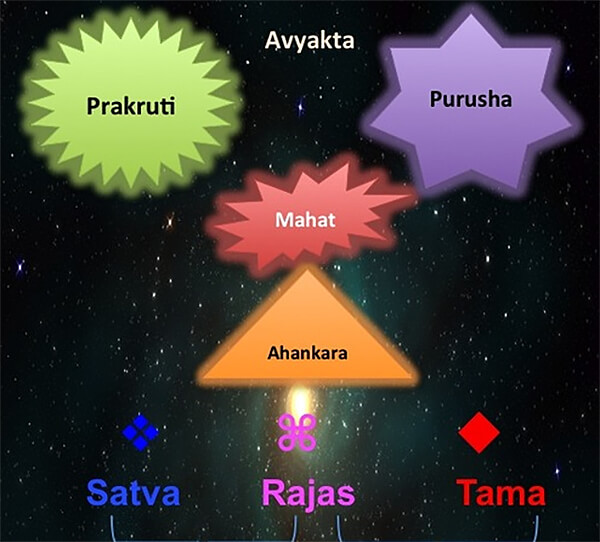
The creation or evolution of the world begins with the samyoga or effective contact of purusha(consciousness) and prakriti(matter).the totality of the karmas of the purushas disturbs the balance of gunas in prakriti and starts the process of evolution. So the first development with in nature upon contact with purusha is disbalance in the three qualities or gunas namely sattva(purity, dispassion and light),rajas(activity, passion and intensity)and tamas(inactivity, ignorance and darkness). As a result of the gunas mixing with one another, the first product of evolution of prakriti is mahat or buddhi( the cosmic intellect). It is the natural function of buddhi to manifest itself and other things. Buddhi is different from purusha or the self which goes beyond all physical things and qualities. But it is the base of all intellectual processes in all individual beings. After that the second product that arises directly out of mahat is called ahankara (cosmic ego, the principle of individuation). The function of ahankara is the feeling of “I and mine” (abhimana) it is because of ahankara that the self considers itself wrongly indeed to be an agent or a cause of action. A desirer of and striver for end and a feeling of ownership. There are three kinds of ahankara according to the predominance of one or the other three gunas.
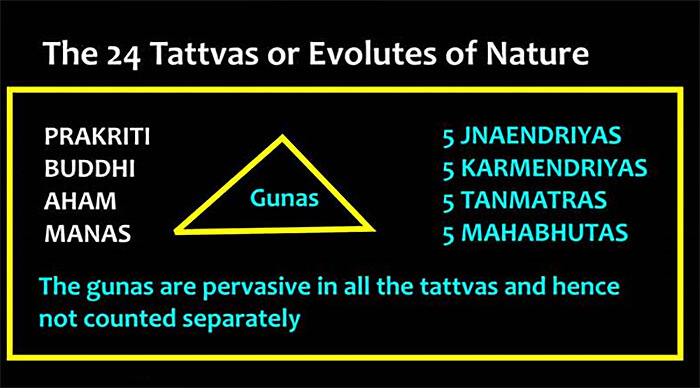
The first one is called vaikarika or sattvika when the element of sattva predominates in it, second one is called taijasa or rajasa when the element of rajas predominates and the third one is called bhutadi or tamasa when the tamas element predominates. The sattva ahankara gives rise to the eleven organs, namely the five organs of perception (jnanendriya), the five organs of action (karmendriya), and the mind (manas). The tamasa ahankara gives rise to five subtle elements of earth, water, fire, air and ether (tanmatras). They further evolve into the five mahabhutas or gross elements (of earth, water, fire, air and ether). The rajas ahankara is involved in both the sattvika and tamasa ahankara, and supplies the energy needed for the change of sattva and tamas into their products.
In all, including the prakriti , there will now be 24 cosmic principles or elements. The rest of creation takes place by their permutation and combination, each purusha getting involved with a psycho-physical complex(body)according to his deeds (karma). There are two stages of evolution namely the psychical and the physical. The history of the evolved universe is a play of twenty four principles, of which prakriti is the first, the five gross elements are the last, and the thirteen organs(karanas)and five tanmatras are the intermediate ones.
The 24 realities (tattvas) emerge or evolve out of nature (prakriti) each having the predominance of one or more gunas. The 24 tattvas or evolutes of nature are:
- Prakriti(Nature)
- Mahat(The Great Principle)
- Buddhi(Discriminating, Reasoning and Causative Intelligence)
- Ahankara(Ego or Ego Principle)
- Manas(The Physical mind or Brain)
- The Five Panchendriyas(Sense Organs)
- The Five Karmendriyas(the organs of action)
- The Five Tanmatras(Subtle Elements)
- The Five Mahabhutas (Gross elements namely the Earth, Water, Air, Fire and other)
For further reading and proper understanding go through the following texts:-
- Bhagwad Gita
- Samkhya Philosophy in details
- Shad Darshans(Six Philosophies of India)